

The digital marketing landscape is undergoing one of its most significant transformations in decades. Search is no longer purely a list of ten blue links. Increasingly, users receive synthesized, AI-generated answers the moment they type a query – answers pulled from content that meets very specific standards of clarity, authority, and structure. This shift has given rise to a discipline called Generative Engine Optimization, or GEO, and it is rapidly redefining what it means to have a well-optimized online presence.
But here’s what most businesses miss: GEO does not operate in isolation. Its success is deeply tied to the quality and intentionality of your website design. When these two forces align, the results go well beyond search rankings – they create a seamless journey from discovery to conversion that traditional SEO strategies rarely achieve on their own.
What Is GEO and Why Does It Matter Now?
Generative Engine Optimization refers to the practice of structuring, writing, and presenting your content so that AI-powered search engines think Google’s AI Overviews, ChatGPT search, Perplexity, and similar tools can accurately extract, cite, and surface your information in response to user queries.
Unlike traditional SEO, which focused heavily on keyword density and backlink volume, GEO prioritizes semantic depth, factual accuracy, clear source attribution, and conversational relevance. For brands looking to stay ahead of this curve, specialized generative engine optimization services can help bridge the gap between static content and AI-ready information. By aligning your data with how LLMs (Large Language Models) process information, you ensure your brand remains visible in the next generation of search. AI engines are trying to answer questions, not just match terms. If your content is written in a way that directly, clearly, and authoritatively addresses specific questions, it becomes prime material for AI citation.
The implication is significant. Being cited by a generative AI engine can expose your brand to millions of users who may never have found you through conventional search results. And when those users click through to your website, what they encounter next determines whether curiosity becomes conversion.
Where Website Design Enters the Equation
This is where most GEO strategies fall apart. Businesses invest in crafting AI-friendly content but neglect the environment into which that traffic arrives. Think of GEO as the magnet that draws people in, and website design as the architecture that guides them forward. One without the other is an incomplete system.
When a user lands on your site after encountering your brand through an AI-generated answer, they arrive with intent. They already have context. They’ve been given a reason to trust you – at least provisionally. Your website has a matter of seconds to validate that trust and channel it productively.
Page speed and technical performance are foundational. AI-referred visitors, much like any web user, will abandon a site that loads slowly. Design decisions – image compression, font loading strategies, clean code structure – directly affect whether visitors stay long enough to convert.
Visual hierarchy and content legibility matter enormously. GEO content tends to be structured around questions and direct answers. Your landing pages and inner pages should mirror this logic. Headers that echo natural-language queries, short punchy paragraphs, and well-placed pull quotes help visitors quickly confirm they’ve landed in the right place. Confusion at this stage kills conversions.
Trust signals and design credibility do heavy lifting. A dated or cluttered website undermines the authority your GEO content worked hard to establish. Consistent branding, clean whitespace, professional photography, visible certifications, and prominently placed social proof all work together to reassure visitors that they’ve found a legitimate, expert source.
Creating a Unified GEO-Design Strategy
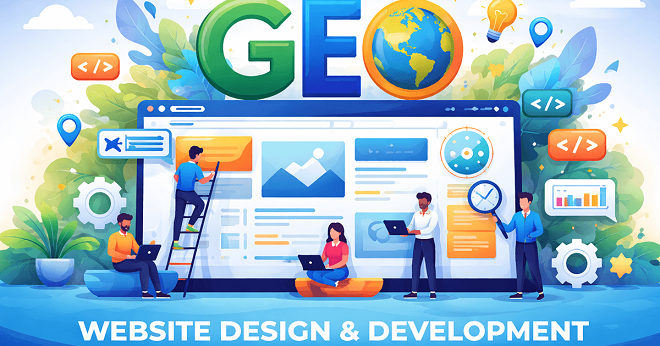
Building a unified strategy requires a holistic view of how users find and interact with your brand. Beyond just answering AI queries, it is critical to recognize why SEO and web design must work together to create a high-performance digital presence. Integrating these two disciplines ensures that your technical SEO supports your design goals, ultimately leading to higher Google rankings and a better user experience.
The most effective approach treats GEO and web design as a single, integrated system rather than two parallel work-streams. Here’s what that looks like in practice.
First, audit your existing content and identify the questions your audience is actively asking AI engines. Use these as the foundation for both your content structure and your page layout decisions. A page built around a specific question – with a direct answer near the top, supporting evidence in the body, and a clear next step at the bottom – serves both AI indexing and human navigation simultaneously.
Second, design your site architecture with information scent in mind. AI-referred visitors often have niche, specific intent. If your navigation is confusing or your internal linking is weak, they’ll lose their way and leave. A clean site structure with logical content clusters reinforces authority to AI engines while reducing friction for human visitors.
Third, align your calls-to-action with the intent stage of your GEO content. Content that gets cited in AI answers tends to be informational or educational. Visitors arriving from these citations are often in research mode, not purchase mode. Design your conversion pathways accordingly offer a lead magnet, a consultation booking, or a resource download rather than a hard product push. This respects where the visitor is in their journey and builds the relationship that leads to eventual conversion.
The Competitive Advantage of Getting This Right
Businesses that treat GEO and website design as complementary disciplines are building compounding advantages. They attract high-intent traffic from AI-generated answers, convert more of that traffic through thoughtful design, and generate the engagement signals – time on site, return visits, shares – that further reinforce their authority in AI training datasets.
As generative search continues to mature, this intersection will only become more consequential. The brands that recognize it now and invest in both disciplines together won’t just rank – they’ll be recommended, trusted, and chosen.
About Author

Founder
David Watson is the founder of DesignDrizzle and is a professional website designer for over 10 years. He has competence in creating visually appealing and user-friendly websites for all the clients. He likes to explore new and creative ideas for designing, photography effects and other inspirational subjects