
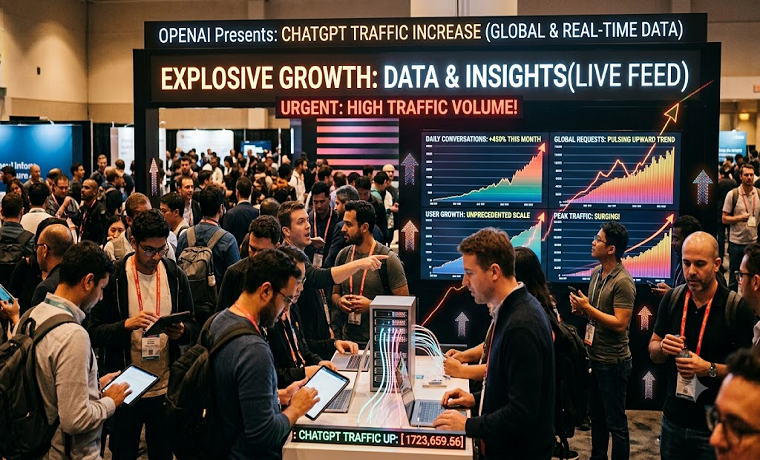
For over two decades, the digital economy operated under a simple, predictable contract: optimize your website for keywords, earn authoritative backlinks, and Google would reward you with user clicks. Today, that framework is fundamentally fracturing. The rapid ascent of conversational platforms like ChatGPT, Claude, and Perplexity has introduced a monumental paradigm shift in consumer behavior. Audiences no longer search through endless pages of blue links; they ask complex questions and receive immediate, synthesized answers.
This dynamic has birthed an entirely new arena: Answer Engine Optimization (AEO) and Generative Engine Optimization (GEO). If your business relies on digital discoverability, ranking on page one of Google is no longer the ultimate goal. The critical question for the modern enterprise is simple: Is your brand being actively cited inside the conversational interfaces where decisions are actually being made? If your site exhibits any of the following five signs, you are likely entirely invisible to AI engines, silently forfeiting massive streams of premium traffic.

1. Your robots.txt File Declares Full-Scale AI Warfare
In the initial panic surrounding intellectual property protection and content scraping, many technical teams implemented aggressive, sweeping blockages within their robots.txt files. Directives specifically banning user-agents like GPTBot, ClaudeBot, or PerplexityBot became standard practice.
While this approach successfully protects data from unauthorized model training, it carries a severe, unintended commercial consequence: it completely blinds these engines during live searches. Modern conversational interfaces increasingly rely on real-time web browsing to answer specific user queries. If a user asks ChatGPT for the best enterprise web designer or software consultant in their area, the engine will crawl the live web to formulate its answer. If your technical architecture slams the door on these specific user-agents, the AI cannot verify your existence, resulting in immediate exclusion from the final response.
2. A Complete Absence of Semantic Schema Markup
Traditional search engines became remarkably proficient at guessing the context of an unformatted page based on text density and basic metadata. Large Language Models (LLMs), however, do not merely match keywords; they construct complex relational maps of real-world entities, products, and services. If your site structure relies solely on basic HTML tags without rigorous JSON-LD schema integration, AI engines will struggle to parse your data efficiently.
Without explicit organizational, product, local business, and review schemas, your site appears as an unstructured wall of text to an AI crawler. Advanced engines prioritize data sources that clearly define who you are, what you offer, and how you are rated. Omitting structured data ensures that your competitors, who provide cleanly formatted semantic context, will consistently secure the coveted AI citations.
3. The “AI Sameness” Trap: Lacking Unfiltered First-Party Data
Conversational models are trained on massive, existing corpora of web data. Consequently, they already thoroughly understand basic, generic definitions and surface-level concepts. If your website content consists primarily of recycled industry generalizations or programmatically generated articles, it holds zero value for an LLM seeking to deliver an authoritative answer to a user.
AI engines look for unique information gains. They actively seek out proprietary statistics, distinct case studies, contrarian expert commentary, and highly specific first-party research. If your digital footprint lacks these distinct markers, the algorithm categorizes your content as redundant. To earn the trust and citation of an LLM, your material must be 100% unique and inherently authoritative.
4. Severe Deficits in Off-Page Digital PR and Third-Party Citations
When an individual asks an AI tool to recommend a premium service or highly rated agency, the model rarely relies exclusively on the target business’s self-published claims. Instead, it references a broad network of external validation, cross-checking industry directories, reputable news publications, and prominent aggregators to form a consensus of authority.
If your digital PR strategy is non-existent, your brand will remain outside the model’s established trust graph. Being left out of authoritative industry roundups, major regional lists, or prominent digital publications means the AI cannot find secondary validation for your business. To build a robust “Share of Model” metric, your brand must be consistently discussed across the wider web ecosystem.
5. Content Lacks Direct, Conversational Intent Architecture
The final point of failure rests on the conceptual architecture of the content itself. Many legacy digital assets are optimized strictly for fragmented search phrases. However, conversational queries are intrinsically natural, detailed, and question-driven. Consumers ask these tools multi-layered questions, seeking immediate, clear, and direct structural answers.
If your content forces the reader to wade through hundreds of words of fluff before arriving at a definitive answer, an AI parsing tool will pass it over. To gain visibility, sections must be engineered with immediate, clear, and definitive summaries. Structuring your writing to directly address specific questions ensures that conversational engines can easily extract and attribute your insights.
Diagnose Your AI Discoverability Instantly
Remaining invisible to AI engines means leaving critical market share on the table. To determine exactly how visible your digital assets are to generative engines, execute an immediate assessment using a reputable diagnostic platforms (GEO tools). Evaluating your current metrics allows you to instantly pinpoint technical barriers, refine your technical structure, and secure your rightful position within conversational search results.
About Author

Founder
David Watson is the founder of DesignDrizzle and is a professional website designer for over 10 years. He has competence in creating visually appealing and user-friendly websites for all the clients. He likes to explore new and creative ideas for designing, photography effects and other inspirational subjects