
The term ‘vibe coding’ is a prominent buzzword in tech and developer communities.
The concept of ‘vibe coding’ has been circulating, often with a mix of jest and earnestness. The question remains: is it a genuine advancement in app and game development or merely a fleeting trend?
So, What Exactly Is Vibe Coding?
In early 2025, Andrej Karpathy, co-founder of OpenAI, coined the term ‘vibe coding’ to characterize a software development methodology. This approach involves programmers utilizing text-based AI tools to generate code by adhering to a conceptual ‘vibe,’ thereby shifting focus away from intricate technical aspects such as code syntax and structure.
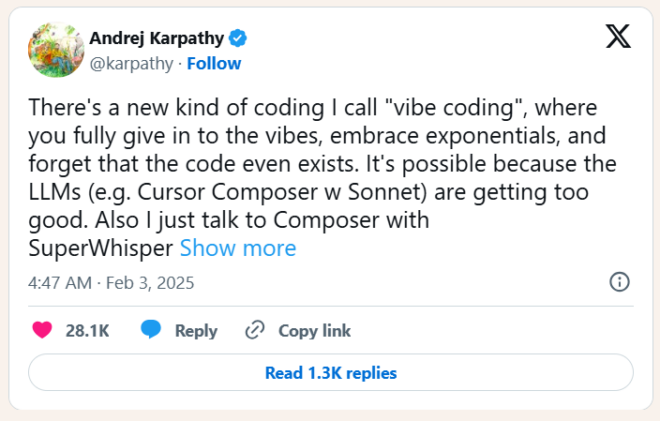
The fundamental principle of this method is that developers can produce code by articulating their requirements to an AI system using plain language.
Rather than immersing themselves in the complexities inherent in programming languages and logic, practitioners of vibe coding depend on large language models like GPT to process their generalized prompts and produce working code.
So, is it a revolution? In a way. Vibe coding isn’t about becoming a programming expert; it’s about letting AI handle the complex coding while the developer focuses on the desired ‘feel’ of the final product.
Vibe Coding’s Appeal: Simple Solution or Oversimplification?
What makes vibe coding so appealing is the theoretical accessibility for all, potentially democratizing app and game development by removing the barrier of deep coding knowledge.
The promise of vibe coding is that anyone can theoretically build apps or games by describing their vision to AI, without the burden of complex frameworks, syntax, or debugging – just ‘vibe it’.
For individuals without prior coding experience, vibe coding presents a compelling opportunity. The availability of AI-driven development platforms, such as Replit, is facilitating the creation of complete, albeit simple, applications within a remarkably short timeframe, even for those lacking technical backgrounds.
However, it’s important to be realistic. Despite sounding like a perfect fix, vibe coding has significant limitations.
One significant distinction is that this approach does not align with traditional software development practices. Although the AI can generate code that executes, its efficiency and maintainability may be compromised.
The Significant Limitations and Risks of Vibe Coding
Despite its potential, vibe coding has significant drawbacks. AI-generated code, though fast, isn’t always dependable or efficient.
A critical issue is the developers’ potential lack of understanding of the generated code, which severely hinders their ability to troubleshoot and resolve errors.
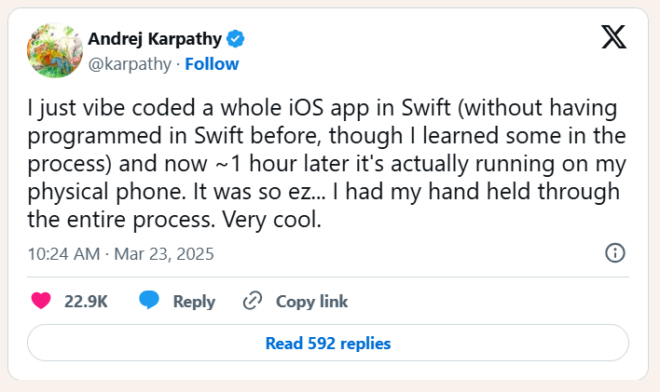
While AI might produce working code initially, it can be inefficient, bloated, and potentially wrong, raising concerns about long-term scalability.
Ultimately, if you don’t understand the tool, how can you trust its performance, especially when scaling or optimizing?
Another downside is that developers using AI for speed often get stuck with unoptimized code that isn’t quite right for their projects… which then requires others to fix.
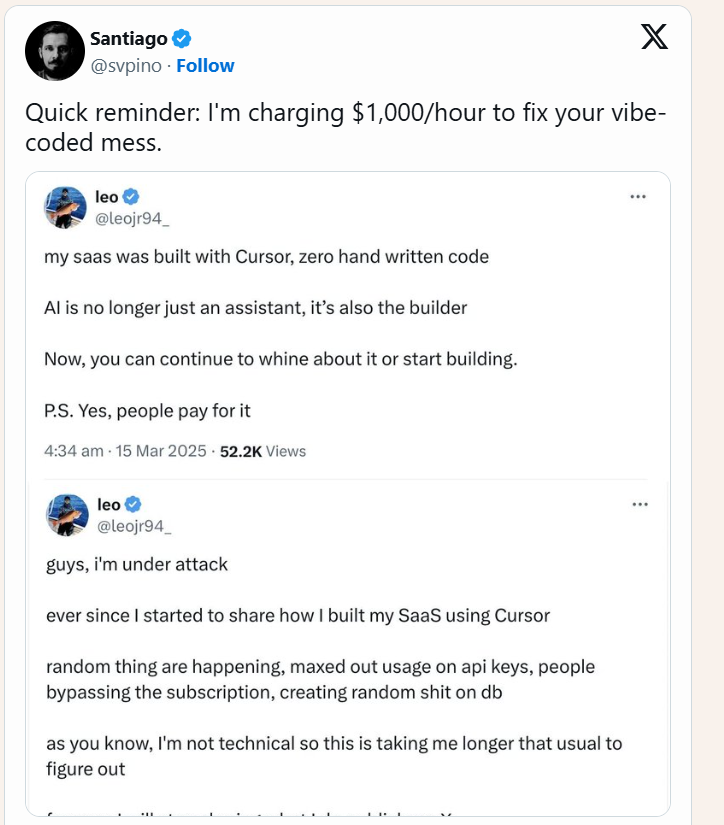
While vibe coding could work for minor projects or prototypes, it’s not the same for demanding apps or serious game development.
Even if the process feels fun or ‘vibey,’ you can’t build a critical product on code that’s essentially a black box to you.
Personal vs. Production: A Vibe Coding Reality Check
Vibe coding is a fresh and fun way to try things out, but knowing its limits is key for effective use.
Given their limited scope and budget, personal projects, prototypes, and low-cost apps are less susceptible to failure from potentially imperfect vibe-coded solutions, making it a relatively safe choice.
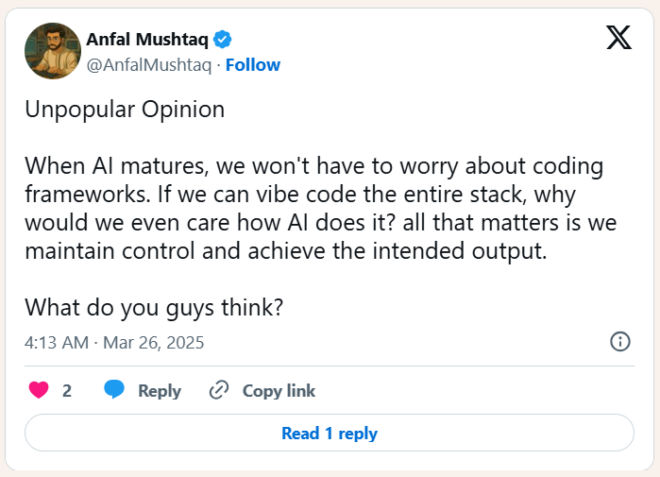
When considering professional-level applications or games that demand stringent performance metrics, optimization, and future scalability, vibe coding is not the appropriate methodology. Its utility lies more in rapid initial development rather than in establishing a durable and scalable software architecture.
In fact, numerous experts draw a parallel between vibe coding and the time-constrained, performance-flexible nature of a game jam. While promoting rapid experimentation and creativity, this methodology entails substantial trade-offs in the final output.
Vibe Coding’s Future: Evolution, Not Revolution
Rather than a replacement for traditional coding or a universal solution, vibe coding is a tool that proves particularly beneficial for low-stakes projects, exploring new concepts, or developing proofs of concept.
For developers with a solid foundation, vibe coding accelerates the process and facilitates quick idea testing, bypassing syntax complexities.
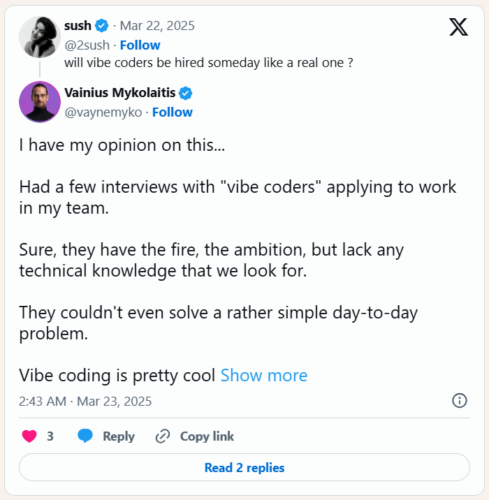
Nonetheless, vibe coding should not be considered a universally applicable solution. Its strengths lie in facilitating rapid prototyping, personal projects, and small-scale applications, as opposed to the creation of robust and scalable production software.
Vibe coding will likely carve out a niche similar to drag-and-drop website builders, which were great for small businesses but not for complex web development.
Is This a Glimpse into the Future or Just a Fun Coding Exercise?
This exciting concept, vibe coding, is enabling a wider range of individuals to experiment with app and game creation.
Vibe coding provides a significant advantage to non-coders, enabling them to develop their ideas without the need to learn complex traditional coding. However, experienced developers see it as a helpful tool only, not as a game changer.
The future of vibe coding will be determined by whether it can evolve towards cleaner, more efficient code generation, or if it will stagnate as a quirky, fun shortcut for small, unsustainable projects.
About Author

Founder
David Watson is the founder of DesignDrizzle and is a professional website designer for over 10 years. He has competence in creating visually appealing and user-friendly websites for all the clients. He likes to explore new and creative ideas for designing, photography effects and other inspirational subjects