
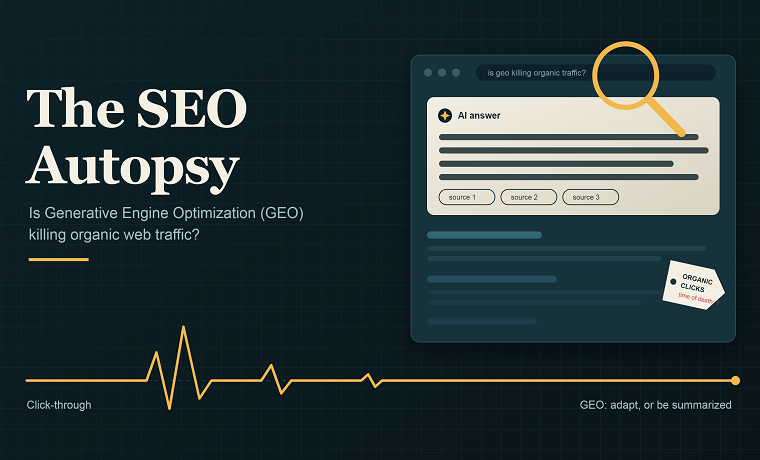
For two decades, the bargain between search engines and publishers was simple. Publishers produced useful pages, search engines ranked them, and users clicked through. Everyone got something: users found answers, publishers earned visits, and search engines sold ads against the whole arrangement. That bargain is now under strain. AI-powered search experiences answer questions directly on the results page, often leaving the user with no reason to visit the source. The question haunting marketers and publishers alike is whether Generative Engine Optimization, or GEO, is the cure for this shift or simply the name we have given to the autopsy.
The Zero-Click Reality
Zero-click behavior did not begin with generative AI. Featured snippets, knowledge panels and “People Also Ask” boxes had already been nibbling at clicks for years. But AI-generated summaries changed the scale of the problem. Instead of a snippet that hints at an answer and invites a visit, the user receives a complete, conversational synthesis drawn from many sources at once. A query like “how do I choose a standing desk” once sent traffic to review sites, buying guides and forums. Today it can produce a finished comparison without a single outbound click.
The consequences ripple outward. Informational content, the backbone of blog-driven marketing funnels, is the most exposed. Recipe sites, how-to publishers, travel bloggers, affiliate reviewers and niche media outlets built their economics on top-of-funnel visits. When those visits thin out, ad impressions fall, affiliate commissions shrink and email list growth stalls. The dashboard still shows impressions rising, because pages are being seen by machines and surfaced in summaries, but the clicks that pay the bills do not follow.
Side A: Adapt or Disappear
Advocates of GEO argue that nostalgia is not a strategy. Audiences are moving to answer engines, and visibility inside those answers is the new real estate. If a brand is cited, recommended or named by a language model, it shapes decisions at the moment of intent, even without a click. Ignoring this channel, they say, is like ignoring mobile in 2010 because desktop traffic still looked healthy.
GEO practitioners focus on becoming a source that models trust and quote. That means writing clear, direct answers near the top of a page, structuring content with unambiguous headings, supporting claims with original data and named expertise, and using schema markup so machines can parse entities and relationships. It also means building authority beyond your own domain: mentions in reputable publications, consistent brand descriptions across the web, and active presence in the communities that models tend to learn from. The goal shifts from “rank number one” to “be the answer the model reaches for.”
The pragmatic argument is that brand impressions inside AI answers can still drive value. Users who do click through from an AI citation are often further along in their decision, which can raise conversion rates even as raw traffic falls. In this view, marketers should trade volume for intent, measuring success through branded search growth, direct visits, assisted conversions and share of voice in AI responses rather than sessions alone.
Side B: Piracy Dressed as Innovation
Critics see something far darker. Generative engines, they argue, are built on the unpaid labor of the very creators they now starve. Journalists, researchers and independent bloggers invested time and money producing material, which was then ingested, compressed and served back to users under the engine’s own brand. The publisher bears the cost of creation while the platform captures the audience, the attention and the advertising revenue.
This is why the language of piracy resonates. A traditional search engine sent users to the source; an answer engine substitutes for it. Retaining the user on the platform is not an accident but a business objective. When an AI summary paraphrases a carefully reported article closely enough that the reader feels no need to visit, the publisher has been displaced by its own work. Lawsuits from news organizations, authors and media companies reflect this grievance, and licensing deals struck by some large publishers suggest that even the platforms recognize content has a price, though those deals tend to favor big players while independent creators are left outside the room.
The economic argument is stark. If creators cannot earn a living, they will stop producing, and the supply of fresh, high-quality information that models depend on will degrade. Critics describe this as a self-defeating loop: machines trained on human knowledge undermine the humans who generate it, then must learn from an increasingly polluted pool of machine-written text.
The Uncomfortable Middle
Both camps hold part of the truth, and the tension between them is what makes the debate hard. GEO is a rational response for an individual business, yet it can feel like helping the arsonist fireproof your house. Every publisher that optimizes content for easy extraction makes the engine’s job simpler and strengthens the habit of consuming answers without visiting sources. Adaptation can accelerate the very trend it responds to.
At the same time, refusing to participate carries its own risk. Blocking crawlers may protect content on principle, but it can also erase a brand from the conversations where buying decisions begin. Some publishers are experimenting with a hybrid approach: allowing access in exchange for licensing fees, gating premium material, or publishing summary-friendly content publicly while keeping deep analysis, tools and community features behind a login. The aim is to give machines enough to mention the brand but not enough to replace it.
What Survives the Autopsy
Not every kind of content is equally vulnerable. Generic explanations, commodity listicles and rewritten consensus are easily absorbed by models, because they add little that a model cannot already produce. What resists substitution is what a language model cannot manufacture: firsthand experience, original research, proprietary data, distinctive opinion, live reporting and genuine community. A hands-on product test with real photographs and measurements has a better claim on a click than a summary of specifications.
Owned channels also gain importance. Email newsletters, podcasts, memberships and direct relationships with readers do not depend on any intermediary’s algorithm. Brands that treat search as one channel among many, rather than their entire lifeline, are better positioned to survive volatility. Diversification is no longer a cliché; it is risk management.
The Verdict
Is GEO killing organic web traffic? Strictly speaking, GEO is a symptom and a response, not the cause. The decline is driven by answer engines changing user behavior, and GEO is the scramble to stay relevant within that new behavior. Organic traffic is not dead, but the easy, high-volume informational clicks that once sustained countless sites are shrinking, and they are unlikely to return in their old form.
The deeper question is not a marketing one but a structural one: who should be paid when knowledge is repackaged by machines? Until regulators, courts and platforms settle on fair compensation, publishers must play a dual game. They should optimize enough to stay visible, build enough direct audience to stay independent, and advocate loudly for a system in which the people who create the web’s value are not the ones left unpaid by it.
About Author

Founder
David Watson is the founder of DesignDrizzle and is a professional website designer for over 10 years. He has competence in creating visually appealing and user-friendly websites for all the clients. He likes to explore new and creative ideas for designing, photography effects and other inspirational subjects